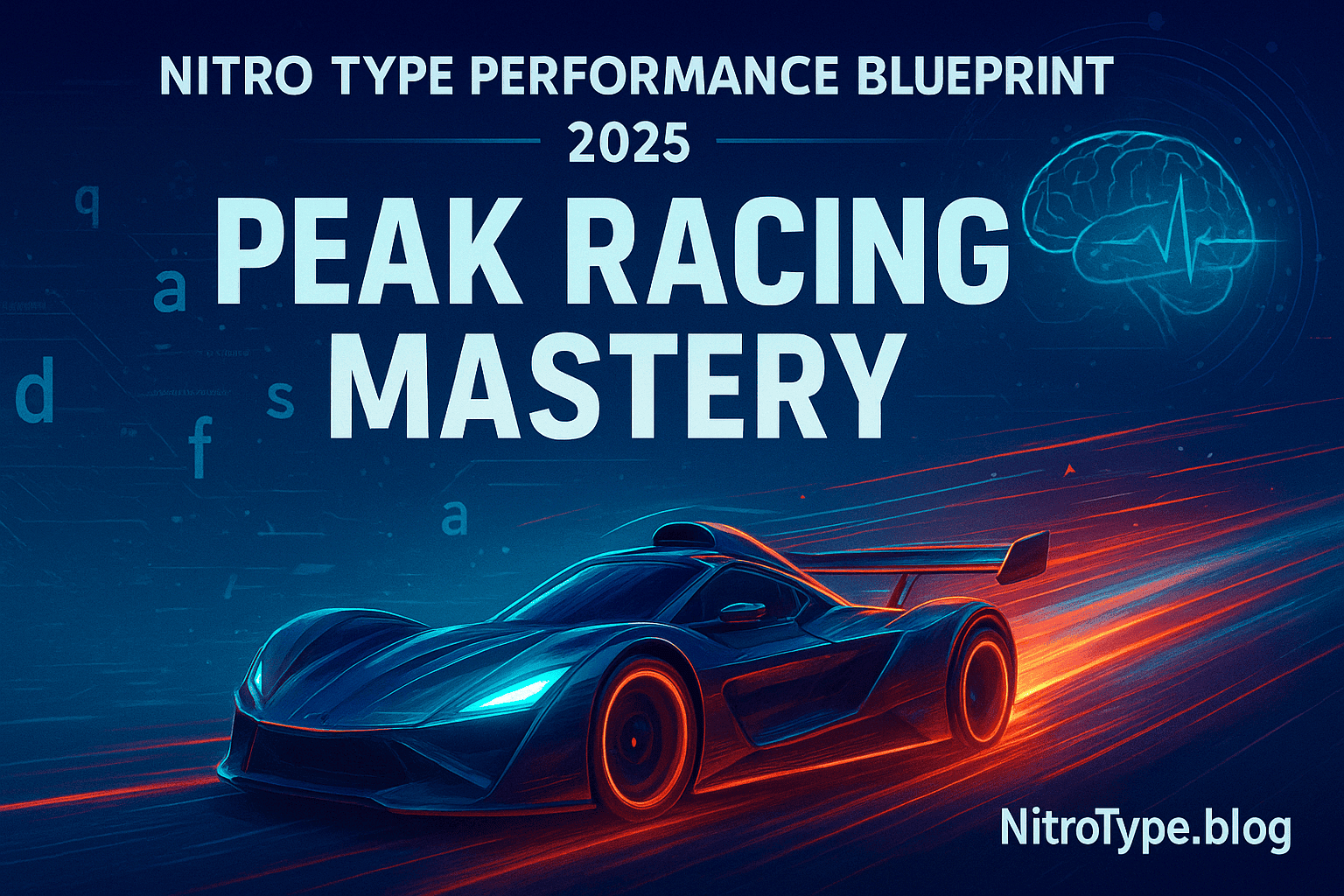
Nitro Type Performance Blueprint 2025: Decode Hidden Racing Patterns for Peak Speed Mastery
Typing fast is only one part of winning in Nitro Type. What truly separates average racers from elite competitors in 2025 is an invisible system of patterns, timing signals, and decision-making rhythms that shape every millisecond of a race. These hidden systems combine into what we call the Nitro Type Performance Blueprint — a structured way to understand how your brain, eyes, and hands work together to create speed, rhythm, flow, and racing precision.
Most racers believe that faster fingers equal faster WPM. But high-level Nitro Type performance proves the opposite: your fingers only execute what your mind has already predicted. Speed begins inside the brain long before your hands make the first keystroke. The Nitro Type Performance Blueprint reveals how cognitive timing, predictive scanning, micro-rhythm control, and behavioral patterns create reliable, repeatable racing success.
This in-depth guide will help you unlock the hidden patterns behind elite racing performance — patterns you’ve never consciously noticed but use in every single race.
Table of Contents
Understanding Why a Performance Blueprint Matters
Typing in Nitro Type is essentially rapid decision-making. Every letter, every word, every sequence forces your brain to evaluate the fastest and most accurate path forward. The milliseconds between these decisions separate average racers from elite competitors.
Racers who struggle typically fall out of rhythm, overshoot words, or backspace too aggressively. These issues are rooted in micro-timing — not mechanical skill. As highlighted in the insights from Nitro Type Race Rhythm Analysis 2025, rhythm becomes a predictive engine that impacts your WPM even more than raw speed.
Racers who learn how to stabilize their decision loops dramatically improve both speed and accuracy. This is the foundational purpose of the Nitro Type Performance Blueprint — to show you how your typing behavior forms patterns that can be optimized for peak performance.
The Nitro Type Performance Blueprint Explained
The Nitro Type Performance Blueprint is a framework that breaks down typing performance into deeply interconnected systems. It does not focus on simple “type faster” advice. Instead, it reveals the architecture behind elite racing:
1. Predictive Word Processing
Elite racers do not read words one at a time. They scan ahead, forming micro-predictions about upcoming sequences.
2. Cognitive Rhythm Stability
Typing rhythm is not about speed — it’s about pattern consistency.
3. Micro-Timing Awareness
Every tiny hesitation, finger lift, or visual misalignment affects your WPM.
4. Behavioral Pattern Mapping
Long-term habits shape your reaction timing and racing flow.
5. Accuracy-to-Speed Conversion
Accuracy is not the opposite of speed — accuracy is the foundation that unlocks higher WPM ceilings.
These five elements make up the structural blueprint of high-level Nitro Type performance.
The Science Behind Micro-Timing and Performance
Modern speed typing research shows that accuracy, reaction speed, and cognitive flow are more important than raw finger movement. A large peer-reviewed study published on SpringerOpen revealed that typing behavior is shaped by predictive processing and split-second correction patterns — exactly the same patterns that determine success in Nitro Type racing.
This research directly supports the idea that the Nitro Type Performance Blueprint is rooted in cognitive efficiency rather than mechanical movement. When racers improve micro-timing — the space between each keystroke — they dramatically increase their stability, accuracy, and top-end speed.
Pattern Recognition: The Heart of the Performance Blueprint
Elite racers rely on pattern recognition far more than speed drills. They develop invisible mental shortcuts that reduce cognitive workload.
Predictive Word Mapping
Instead of waiting for each word to appear, top racers pre-process incoming text:
- They identify word shapes.
- They recognize letter patterns.
- They anticipate sequences before typing them.
This reduces mental load and keeps rhythm stable, especially during long or complex sentences.
Micro-Timing Loops and Cognitive Intervals
Micro-timing loops are tiny gaps between key presses. These gaps might seem insignificant, but they define your racing consistency.
For example:
- A 20–30 ms hesitation
- A brief blink during long words
- A momentary pause after punctuation
These micro-events happen subconsciously, but they accumulate and reduce race efficiency.
The Nitro Type Performance Blueprint teaches racers to identify and train these micro-patterns until they become fluid.
Mastering Racing Rhythm and Flow State
Flow state is the peak of racing performance — total immersion, perfect attention, and zero cognitive friction. To reach flow, racers must understand their natural rhythm.
Identifying Your Natural Typing Rhythm
Your rhythm is the tempo at which your mind and hands sync.
Signs of a strong rhythm include:
- Stable accuracy
- Smooth eye movement
- Predictable WPM increases
- Minimal backspacing
A disrupted rhythm is the root cause of sudden speed drops.
Reaction Timing and Flow State
A major part of the Nitro Type Performance Blueprint is understanding how reaction timing influences your racing flow. Insights from Nitro Type Reaction-Time Intelligence 2025 reveal that even tiny delays — often less than 100 ms — can shift you out of flow and reduce your overall WPM.
Elite racers maintain flow by keeping mental friction near zero. Every shift of attention breaks performance stability.
Behavioral Patterns That Shape Elite Racer Performance
Behavioral patterns — not keyboard skills — determine long-term Nitro Type growth.
Habit Formation in Nitro Type
Your daily racing behavior creates automatic patterns:
- How you position your eyes
- How you react to mistakes
- How you accelerate in the opening seconds
- How you stabilize speed in long sequences
These micro-habits become your racing fingerprint.
Identifying Mental Bottlenecks
Most performance issues are mental:
- Overthinking during long words
- Panic typing
- Overcorrecting mistakes
- Fearing difficult sequences
These tendencies are psychological, not mechanical. Research shows that racers who understand their own behavior improve faster. This aligns with insights from Nitro Type Behavioral Insights 2025, where player habits directly influence long-term performance stability.
Building Your Own Nitro Type Performance Blueprint
Now we take the conceptual blueprint and turn it into a systematic, personalized performance plan.
Step 1: Analyze Your Own Typing Data
Look for:
- WPM fluctuations
- Burst speed versus sustained speed
- Error clusters (words where accuracy collapses)
- Mental pauses (subtle hesitation)
- Overcorrection tendencies
This creates your baseline blueprint.
Step 2: Identify Weak Points in Your Racing Patterns
Common weak patterns include:
- Long-word hesitation
- Rhythm collapse after punctuation
- Overuse of backspace
- Misalignment between eyes and hand movement
- Mid-race fatigue or cognitive overload
You can only improve what you understand.
Step 3: Create a Customized Training System
The Nitro Type Performance Blueprint becomes powerful when personalized:
- Focus on predictive scanning drills
- Train with rhythm-stability exercises
- Practice typing in controlled tempo (not pure speed racing)
- Use accuracy-first sessions to remove correction anxiety
Over time, micro-patterns realign naturally.
Advanced Strategies to Maximize Speed With Blueprint Training
Reaction Optimization Techniques
Elite racers optimize reaction patterns, not finger speed:
- Controlled breathing
- Maintaining consistent visual depth
- Avoiding unnecessary eye jumps
- Reducing environmental distractions
These subtle strategies compound into massive WPM improvements.
Accuracy-to-Speed Expansion
Accuracy expands your speed potential.
Think of accuracy as the “pressure valve” of your speed ceiling.
As accuracy improves:
- Cognitive load decreases
- Micro-corrections disappear
- Rhythm stabilizes
- WPM naturally increases
This is a core principle of the Nitro Type Performance Blueprint.
Practical Examples of Blueprint-Based Racing Improvements
Example 1: Rhythm Disruption Case
A racer jumps from 95 WPM to 55 WPM mid-race.
Blueprint diagnosis: Punctuation triggered a rhythm reset.
Example 2: Overcorrection Loop
A racer hits backspace 20+ times in one race.
Blueprint solution: Accuracy-first drills to rebuild predictive trust.
Example 3: Visual Lag Pattern
A racer slows down during long paragraphs.
Blueprint training: Eye-tracking exercises and predictive scanning.
These real examples show how racers break negative patterns by understanding invisible performance loops.
Common Blueprint Mistakes to Avoid
- Training only for speed
- Forcing rhythm instead of discovering natural tempo
- Ignoring accuracy drops
- Neglecting mental performance habits
- Practicing too fast, too early
- Not recording personal typing data
Avoiding these mistakes protects long-term progress.
Conclusion — The Future of Nitro Type Performance Optimization
The Nitro Type Performance Blueprint represents a new era of racing mastery. Instead of focusing on raw speed alone, racers now understand how hidden mental patterns, micro-timing, predictive processing, and behavioral habits shape every race.
Racers who learn to decode these patterns unlock performance levels far beyond traditional training methods. This blueprint turns typing into a predictable, optimized, data-driven skill — one that can be trained with precision and purpose.
In 2025, Nitro Type racing isn’t about typing harder.
It’s about typing smarter — with rhythm, prediction, stability, and deep cognitive awareness.
Master your blueprint.
Master your speed.

Hi, I’m Kamran Khatri, the author behind NitroType.blog. I share typing speed tips, Nitro Type updates, gaming tricks, and productivity hacks to help you type faster and smarter. My goal is to make typing fun while helping you improve your skills like a pro. If you’re passionate about typing or want to level up your Nitro Type game, you’re in the right place!