Nitro Type Skill Transfer in 2026: How Typing Races Build Real-World Digital Power Beyond the Game
Typing games are often dismissed as “just for fun,” but in 2026, that assumption no longer holds up. As digital work, AI tools, remote education, and online careers dominate daily life, the ability to type quickly, accurately, and consistently has become a core digital skill. This is where Nitro Type skill transfer becomes highly relevant.
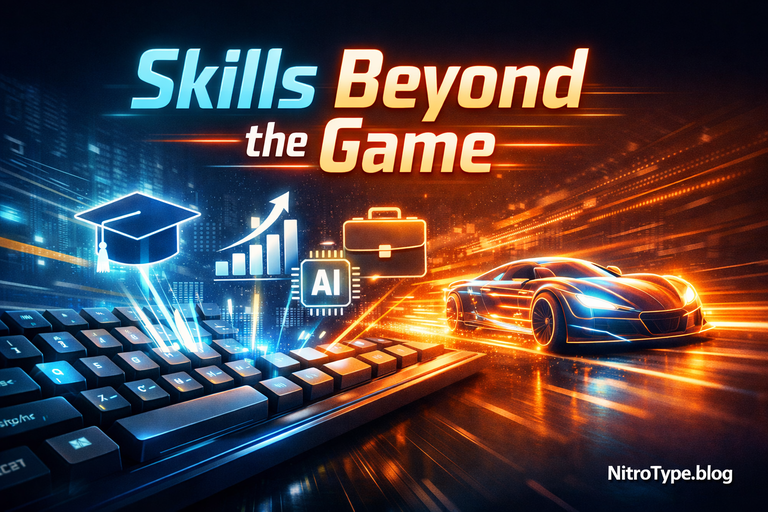
Nitro Type is not just a racing game—it is an unintentional training ground for transferable skills that directly impact academics, productivity, careers, and modern AI-driven workflows. This article explores how and why those skills transfer, where they apply in the real world, and how to maximize their long-term value beyond the game.
Table of Contents
What Is Skill Transfer—and Why Nitro Type Fits Perfectly in 2026?
What does “skill transfer” actually mean, and why does Nitro Type matter today?
Skill transfer refers to the ability to apply skills learned in one context to another. In 2026, when keyboards remain the primary interface between humans and technology, Nitro Type naturally trains foundational typing and cognitive skills that transfer seamlessly into real-world digital environments.
Unlike static typing lessons, Nitro Type places players in time-pressured, feedback-driven situations. This combination mirrors real digital tasks such as exams, professional writing, data entry, coding, and AI prompt engineering—making the transfer far more effective.
Near Transfer vs. Far Transfer in Typing Skills
- Near transfer happens when Nitro Type improves general typing speed, accuracy, and rhythm.
- Far transfer occurs when those same skills enhance performance in school exams, online jobs, content creation, and productivity tools.
Nitro Type succeeds at both because it blends repetition, motivation, and performance feedback into every race.
How Nitro Type Builds Core Typing Foundations That Carry Over
Does Nitro Type actually improve real typing ability?
Yes—because it reinforces the same mechanical foundations required for professional typing: finger independence, muscle memory, visual word processing, and rapid correction under pressure.
Every race forces players to type complete words and sentences without stopping, which conditions the brain to treat typing as an automated process rather than a conscious effort.
Muscle Memory, Home Row Discipline, and Pattern Recognition
One of the most transferable outcomes of Nitro Type is improved muscle memory. Over time, players stop “thinking” about keys and start reacting automatically. This aligns directly with how touch typing works in real environments.
As explained in how touch typing skills improve academic performance, proper finger placement and repeated practice reduce cognitive load. When less mental energy is spent locating keys, more focus can be applied to understanding questions, forming arguments, or processing information—skills that matter far beyond racing.
Nitro Type trains this subconsciously, which is why many players notice they type faster everywhere, not just in the game.
Speed Isn’t the Goal—Consistency Is the Transferable Advantage
Is raw speed the most valuable transferable skill?
Not exactly. In real-world scenarios, consistency matters more than short bursts of speed. Nitro Type rewards players who maintain stable performance across entire races, not just those who spike briefly.
This consistency is what transfers into productivity, academic writing, and professional output.
WPM Stability vs. Burst Speed
In real work, typing 85 WPM consistently for 30 minutes is far more valuable than hitting 120 WPM once and crashing afterward. Nitro Type encourages sustained output, which mirrors real-life demands.
This idea is reinforced in this explanation of Word Per Minute (WPM) and practical efficiency, where consistent WPM directly correlates with reduced fatigue, fewer errors, and higher overall output.
Players who race regularly often develop a steady typing rhythm that carries over naturally into long typing sessions at school or work.
Cognitive Skills Nitro Type Trains Without Players Realizing
What mental skills are being trained during races?
Beyond typing mechanics, Nitro Type develops focus, reaction timing, predictive reading, and error recovery—core cognitive abilities that define high-level digital performance in 2026.
Focus, Flow State, and Error Recovery
During races, players must maintain attention for the entire text stream. A single lapse can cause lost ground or accuracy penalties. This trains sustained focus and rapid recovery from mistakes.
These same skills are critical in studying, remote work, and multitasking environments. Research into learning productivity shows that structured, engaging tasks improve attention span over time.
This effect is clearly connected to how Nitro Type enhances student productivity and focus, where racing conditions help students build mental endurance and resist distractions—skills that transfer directly into exams and long study sessions.
Real-World Applications of Nitro Type Skill Transfer
Where do Nitro Type skills actually show up outside the game?
Almost anywhere typing is required—which, in 2026, means nearly every digital activity.
Education, Exams, and Academic Writing
- Faster essay and assignment completion
- Better time management during computer-based exams
- Reduced stress when typing under deadlines
Students who type fluently can focus on answering questions instead of fighting the keyboard.
Freelancing, Content Creation, and Online Work
For bloggers, copywriters, data entry professionals, and virtual assistants, typing speed directly impacts income. Faster typing means:
- Higher output in less time
- Faster client turnaround
- Less physical and mental fatigue
Nitro Type players often transition into these roles with a measurable advantage.
AI Prompting & Digital Workflows in 2026
Even in an AI-powered world, humans still type prompts, corrections, and refinements. Faster, clearer typing allows:
- Quicker AI iterations
- Better prompt clarity
- Higher productivity when editing AI outputs
In this sense, Nitro Type prepares users for the human-AI interface, not replaces it.
The Science Behind Practice, Repetition, and Skill Retention
Why does repetitive racing actually work?
Because repetition combined with feedback strengthens neural pathways responsible for motor learning and automation.
Each Nitro Type race provides instant feedback—speed, accuracy, placement—allowing players to self-correct and improve naturally.
According to Harvard University’s explanation of how consistent practice strengthens learning and performance, repeated skill execution leads to long-term retention. This explains why Nitro Type skills persist even when players step away from the game—the learning is deeply encoded.
Limitations and Risks of Relying Only on Nitro Type
Are there downsides to Nitro Type-based learning?
Yes. While Nitro Type is powerful, it is not perfect on its own.
Speed Chasing vs. Sustainable Typing
Some players develop habits such as:
- Sacrificing accuracy for speed
- Ignoring posture and ergonomics
- Over-relying on racing instead of real writing
Without balance, these habits can limit long-term benefits or even cause strain.
Nitro Type works best when combined with mindful practice and real-world typing tasks.
How to Maximize Skill Transfer from Nitro Type in 2026
How can players intentionally convert racing skills into real-world value?
By applying a few simple strategies consistently.
Practical Skill Transfer Checklist
- Prioritize accuracy-focused races regularly
- Apply typing skills daily in real writing tasks
- Maintain proper posture and breaks
- Reflect on errors instead of ignoring them
- Use Nitro Type as training, not replacement
This approach turns gaming time into measurable skill growth.
The Future of Typing Skill Transfer in an AI-First World
Will typing still matter when AI keeps advancing?
Yes—because speed of input, clarity of expression, and efficiency of interaction remain human advantages.
AI accelerates output, but humans who can:
- Type faster
- Edit quicker
- Iterate ideas efficiently
will always outperform those who cannot. Nitro Type trains exactly this interface skill, making it surprisingly future-proof.
Frequently Asked Questions (FAQ)
Does Nitro Type really help in real typing jobs?
Yes. Many players report faster output, better accuracy, and less fatigue in real typing-based work.
Is Nitro Type better than traditional typing tutors?
It is more engaging and better for consistency, but works best when paired with intentional accuracy and posture awareness.
Can Nitro Type improve exam performance?
Yes, especially in computer-based exams where speed and accuracy reduce time pressure.
How long does skill transfer take?
Most players notice improvements within weeks, with strong transfer after consistent long-term play.
Is Nitro Type still useful in 2026 with AI tools?
Absolutely. Faster typing improves AI prompting, editing, and workflow efficiency.
Conclusion
Nitro Type is no longer just a typing game—it is a digital skill accelerator. In 2026, when keyboards remain central to education, work, and AI interaction, the skills developed through Nitro Type transfer directly into real-world success.
When used intentionally, Nitro Type builds speed, accuracy, focus, and confidence that extend far beyond racing. For students, professionals, and digital creators alike, Nitro Type skill transfer is not accidental—it is a competitive advantage.

Hi, I’m Kamran Khatri, the author behind NitroType.blog. I share typing speed tips, Nitro Type updates, gaming tricks, and productivity hacks to help you type faster and smarter. My goal is to make typing fun while helping you improve your skills like a pro. If you’re passionate about typing or want to level up your Nitro Type game, you’re in the right place!