Typing Muscle Memory Training 2025: Proven Methods to Build Lasting Speed, Accuracy & Consistency
Typing faster is easy. Typing fast every time, under pressure, without mental strain—that’s rare. The difference between temporary speed and lasting performance comes down to one invisible skill: typing muscle memory.
In 2025, the most consistent racers aren’t forcing speed. Their fingers already know what to do. This article breaks down how typing muscle memory really works, how it’s formed, how it’s damaged, and how you can train it correctly to build permanent speed, accuracy, and consistency.
Table of Contents
What Is Typing Muscle Memory and How Does It Really Work?
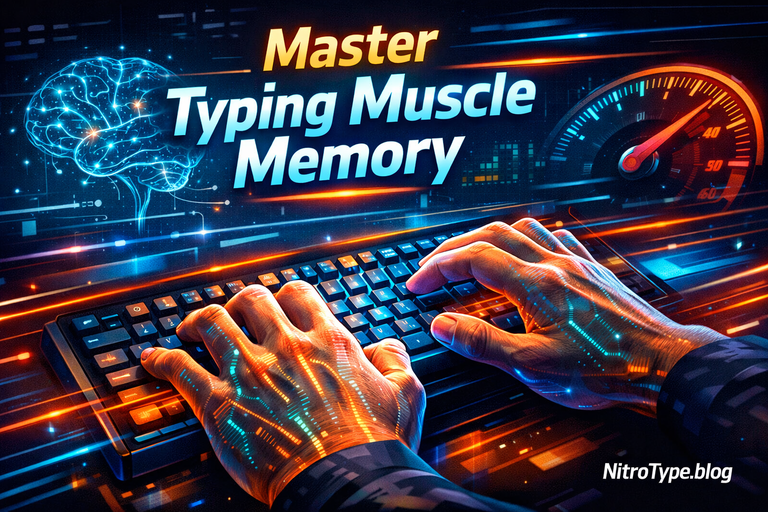
Typing muscle memory is the brain’s ability to execute keyboard movements automatically through repeated, accurate practice. Despite the name, the memory doesn’t live in the muscles—it lives in neural pathways that control movement, timing, and coordination.
When you repeat correct keystrokes consistently, the brain strengthens these pathways. Over time, this reduces the need for conscious control. Typing becomes reflexive instead of reactive, allowing you to maintain speed even when focus drops or pressure rises.
Research summarized by Harvard Health shows that repeated physical actions strengthen memory and learning pathways, helping skills become more automatic and long-lasting. This explains why consistent, accurate repetition is far more effective than frantic speed practice when building real typing muscle memory.
Why Accuracy Is the Foundation of Strong Muscle Memory
Typing muscle memory memorizes whatever you repeat most, whether it’s correct input or constant mistakes. This is why accuracy must come before speed.
Accuracy training is like installing safety rails: it reduces the chance of crashing. Error recovery is the emergency brake and steering system that helps you avoid disaster if something goes wrong. Accuracy lays the foundation, but recovery is what lets you bounce back mid-race.
Racers who ignore accuracy often feel fast but unstable. Their speed collapses the moment pressure increases because their muscle memory contains too many flawed patterns. Understanding this principle is essential, and it’s explained in depth in Why Accuracy Matters More Than Speed in Nitro Type.
Key insight:
Speed doesn’t create skill. Accuracy decides what gets automated.
Repetition vs. Deliberate Practice: Why Endless Racing Isn’t Enough
Not all repetition improves muscle memory. Random racing reinforces existing habits, while deliberate practice actively rewires weak points.
Deliberate practice means:
- Slowing down to eliminate specific recurring errors
- Isolating difficult letter combinations or words
- Practicing control before reintroducing speed
Racers who hit plateaus often discover that they’ve been reinforcing the same mistakes at higher speeds. Resetting fundamentals through structured routines allows the brain to relearn clean movement patterns. This is why many competitive players rebuild their foundation using Best Practice Drills to Improve Nitro Type Accuracy before pushing speed again.
Why it works:
The brain must notice and correct errors before it can automate correct behavior.
Speed, Accuracy, and Consistency: The Muscle Memory Triangle
True typing mastery isn’t about maximum WPM—it’s about repeatable performance. Muscle memory stabilizes speed by balancing accuracy and rhythm into consistency.
A racer who types 95 WPM every race will outperform someone who alternates between 80 and 120. Consistency wins because it reduces mental strain, correction time, and performance anxiety.
Many racers misunderstand this balance, chasing speed while wondering why results fluctuate. If you’re unsure where to focus your training, Typing Speed vs Typing Accuracy: What Should Students Focus On in 2025? explains how these elements work together rather than competing against each other.
Rule of thumb:
Stable speed grows faster than unstable speed.
How Typing Muscle Memory Forms Over Time
Typing muscle memory develops in stages:
Stage 1: Conscious Control
Every keystroke requires attention. Progress feels slow, but mistakes are visible and fixable.
Stage 2: Pattern Recognition
The brain groups letters and words into chunks. Speed increases, but inconsistency is common.
Stage 3: Automation
Typing becomes reflexive. Errors drop, rhythm improves, and performance stabilizes.
Problems occur when racers rush through early stages. Automating flawed patterns leads to fragile muscle memory that collapses under pressure.
Daily Typing Muscle Memory Training Framework
Short, focused sessions outperform long, unfocused practice.
1. Neural Warm-Up (5 minutes)
Type slowly with perfect accuracy. This primes the brain for learning.
2. Precision Block (10–15 minutes)
Work below max speed. Identify and correct recurring mistakes.
3. Speed Integration (10 minutes)
Increase pace gradually while maintaining control.
4. Cool-Down (5 minutes)
End with clean, relaxed typing to lock in correct patterns.
Why this matters:
The brain strongly remembers the patterns practiced at the end of a session.
Common Habits That Destroy Typing Muscle Memory
Many racers unknowingly sabotage progress through:
- Racing while mentally or physically fatigued
- Ignoring repeated error patterns
- Constantly changing keyboards or layouts
- Chasing speed every session without recovery
These habits train instability. Fixing them often unlocks rapid improvement.
How Long Does It Take to Build Strong Typing Muscle Memory?
Progress timelines vary, but most racers experience:
- 2–4 weeks: smoother typing, fewer conscious corrections
- 2–3 months: stable speed gains and better endurance
- 6+ months: deep automation and long-term consistency
The deciding factor is not talent—it’s practice quality.
Frequently Asked Questions
Can bad muscle memory be fixed?
Yes, by slowing down and retraining accuracy before reintroducing speed.
Is muscle memory harder to build as an adult?
No. Adults adapt more consciously, which can lead to cleaner patterns.
Does changing keyboards reset muscle memory?
Partially. Major changes require adjustment, but core skills remain.
How much daily practice is enough?
30–45 focused minutes beats hours of unfocused racing.
The Future of Typing Muscle Memory Training
AI-assisted feedback, adaptive drills, and real-time error tracking are shaping how typing skills are trained in 2025 and beyond. However, technology only accelerates progress when fundamentals are solid. Muscle memory remains the foundation.
Conclusion: Build Once, Benefit Forever
Typing muscle memory is not about pushing harder—it’s about training smarter. When built correctly, it delivers speed, accuracy, and confidence that compound over time. Instead of fighting your fingers every race, you let them perform automatically.
Permanent performance isn’t a shortcut. It’s a system—and now you know how to build it.

Hi, I’m Kamran Khatri, the author behind NitroType.blog. I share typing speed tips, Nitro Type updates, gaming tricks, and productivity hacks to help you type faster and smarter. My goal is to make typing fun while helping you improve your skills like a pro. If you’re passionate about typing or want to level up your Nitro Type game, you’re in the right place!