Nitro Type Language Engine 2026 – Powerful Secrets Behind Smarter, Faster Racing
If you’ve ever wondered why two races at the same speed feel completely different, the answer isn’t your fingers—it’s the language itself. In , performance isn’t decided only by WPM or car stats. Beneath every race lies a hidden system that controls sentence structure, word difficulty, and pacing. In 2026, understanding this Language Engine is the difference between inconsistent finishes and consistent podiums.
This guide breaks down how the language engine works, why it impacts accuracy before speed, how elite racers adapt mid-race, and how you can turn text difficulty into a competitive advantage—without grinding more hours.
Table of Contents
What Is the Nitro Type Language Engine? (And Why It Matters in 2026)
Short answer: the Language Engine decides what you type and how hard it is.
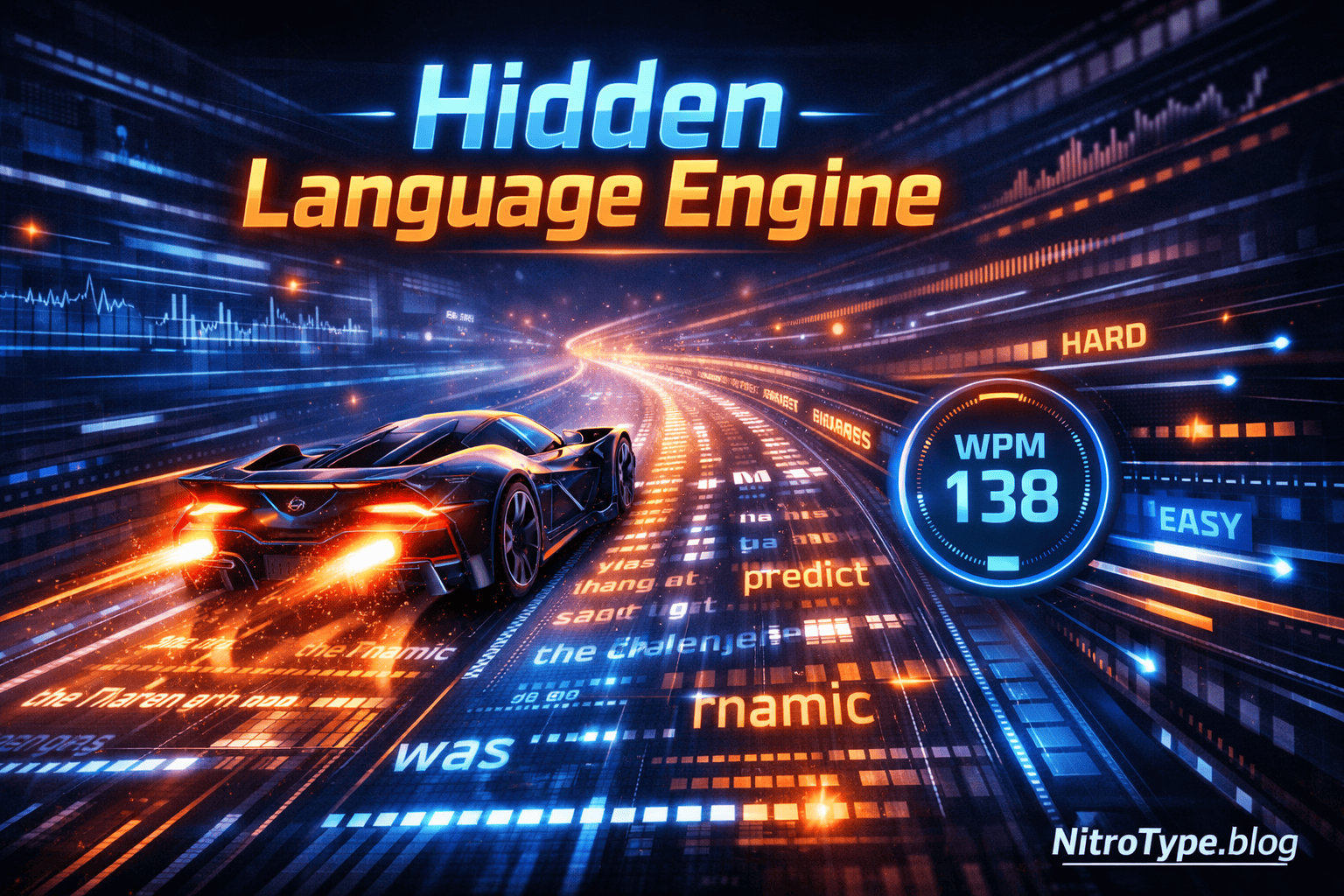
Long answer: it’s the behind-the-scenes system that assembles sentence patterns, selects words, and controls pacing to shape your cognitive load during races.
Unlike static typing tests, Nitro Type doesn’t feed identical difficulty each time. The engine blends short and long clauses, common and awkward words, and fast or breathless pacing. This variability explains why your WPM can stay stable while accuracy spikes—or collapses.
At its core, the engine builds on touch typing fundamentals, where rhythm, muscle memory, and letter transitions matter as much as raw speed (see the research foundation on touch typing). Nitro Type amplifies this by continuously changing the text challenge mid-race.
Sentence Patterns: How Structure Shapes Your Typing Rhythm
Why do some sentences feel smooth while others break your flow?
Because structure determines rhythm. Sentence patterns act like the road surface—straight asphalt or sharp switchbacks.
Short Bursts vs. Long Clauses
- Short, declarative phrases promote momentum. They let your fingers stay in a predictable cadence.
- Long, compound sentences introduce commas, conjunctions, and cognitive pauses. Each pause increases the chance of hesitation.
When patterns align with your internal tempo, you’re more likely to slip into an automatic state. That state—where typing feels effortless—is commonly described as the flow zone. Racers who learn to maintain it gain a measurable edge, as explained in Typing Flow State in Nitro Type.
Pro insight: Elite racers don’t read word-by-word. They chunk phrases. Sentence patterns that resist chunking (unexpected clauses, mid-sentence pivots) disrupt that advantage.
Word Difficulty: Why “Easy” Words Can Be Harder Than Long Ones
Is a shorter word always easier?
Not in Nitro Type.
Familiarity vs. Finger Transitions
Word difficulty isn’t just length—it’s keyboard geometry and habit strength.
- Words with awkward hand alternation (e.g., repeated same-finger transitions) slow you down.
- Uncommon letter sequences increase micro-hesitations.
- Familiar words typed thousands of times are often faster—even if they’re longer.
This explains a common paradox: racers drop accuracy on “simple” words while flying through longer, familiar ones. It also reinforces a key lesson—speed without precision collapses under language pressure. The balance between the two is explored deeply in Typing Speed vs Typing Accuracy.
Pro insight: Train recognition, not memorization. The faster your brain predicts letter clusters, the less the language engine can slow you.
Pacing Mechanics: How Nitro Type Controls Your Mental Breathing Room
Why does one race feel rushed and another calm—at the same WPM?
Because pacing decides whether your brain gets micro-rests.
Continuous Strings vs. Natural Pauses
- Continuous strings (few commas, tight word spacing) elevate mental load.
- Natural pauses reset focus and reduce cascading errors.
Sentence pacing is like racing without pit stops. Accuracy training is the safety rail that keeps you on track—but mistakes still happen. Error recovery is the emergency brake and steering system that prevents disaster after a slip. Racers who master recovery techniques can stabilize momentum mid-race by applying strategies from Nitro Type Error Recovery Mechanics instead of panicking after one typo.
Pro insight: When pacing tightens, consciously ease speed by 2–3%. That tiny adjustment preserves accuracy and often improves final placement.
How the Language Engine Impacts Accuracy Before Speed
Does language difficulty hit accuracy first?
Almost always—yes.
Speed declines are visible, but accuracy failures are silent until they compound. Complex sentence structures increase:
- Error probability
- Correction time
- Mental fatigue
One uncorrected error can trigger a chain reaction: hesitation → rushed correction → second error. This is why many racers feel they “randomly” collapse despite stable speed metrics.
Pro insight: Treat accuracy as an early warning system. When it dips, the language engine is pushing your cognitive limits.
Real Race Scenarios: Why You Lose Races You “Should” Win
Scenario A:
You race at 95 WPM with dense, clause-heavy sentences. Accuracy slips to 94%. You finish 4th.
Scenario B:
You race at 90 WPM with smoother pacing and familiar words. Accuracy holds at 99%. You win.
The language engine tilted the field—not your car or reaction time. Nitro Type rewards clean execution under variable text, not theoretical max speed.
Benefits of Understanding the Nitro Type Language Engine
What changes when you understand the system instead of fighting it?
- Consistency: fewer unexplained losses
- Endurance: longer sessions with less fatigue
- Adaptability: smarter speed modulation
- Confidence: control replaces frustration
Racers who read text patterns early gain a strategic edge that raw grinders miss.
Risks of Ignoring Language Mechanics
What happens if you ignore sentence difficulty and pacing?
- You misdiagnose plateaus as “slow fingers”
- You overtrain speed and undertrain control
- You burn out chasing numbers that language complexity erases
Most stalled racers aren’t stuck—they’re misaligned with the language engine.
How Elite Racers Adapt to Language Difficulty (Without Slowing Down)
Do top racers type differently?
They adapt intelligently.
Elite Micro-Adjustments
- Slight speed modulation during dense text
- Anticipation of awkward letter paths
- Immediate correction strategy (not panic correction)
- Rhythm preservation over brute force
They don’t fight the language engine—they ride it.
The Future of the Nitro Type Language Engine Beyond 2026
Looking ahead, expect:
- Adaptive difficulty based on performance consistency
- Smarter sentence scaling tied to accuracy history
- Personalized pacing profiles
- Language systems that reward control, not spam speed
Typing races are moving from raw mechanics to cognitive performance.
FAQs
Does Nitro Type adjust sentence difficulty dynamically?
Yes. Sentence patterns, word choice, and pacing vary to test adaptability.
Why do some races feel mentally exhausting?
High cognitive load from dense sentence structures and tight pacing drains focus faster than speed alone.
Can understanding sentence patterns improve WPM?
Indirectly. Better rhythm and fewer errors often raise effective WPM.
Is accuracy more important than speed?
In most competitive races, yes. Accuracy preserves momentum when language difficulty spikes.
Conclusion: Speed Is Visible—Language Control Is Invisible Power
Everyone sees WPM. Few understand the language shaping it. The Nitro Type Language Engine 2026 rewards racers who read patterns, respect pacing, and protect accuracy under pressure. Master the text, and speed follows naturally.
In Nitro Type, the fastest fingers don’t always win—the smartest readers do.

Hi, I’m Kamran Khatri, the author behind NitroType.blog. I share typing speed tips, Nitro Type updates, gaming tricks, and productivity hacks to help you type faster and smarter. My goal is to make typing fun while helping you improve your skills like a pro. If you’re passionate about typing or want to level up your Nitro Type game, you’re in the right place!